
- herdr v0.5.0 turns its terminal agent multiplexer into a real background session server.
- Close your laptop with Claude Code still running, open your phone, SSH in, type herdr, and you're back in the same workspace with the same agents.
- No app, no cloud, just a single Rust binary.
TL;DR
herdr v0.5.0 (released April 21, 2026) ships a persistent server/client session model. Quit the UI, close the terminal, shut the laptop — your Claude Code, Codex, Pi and OpenCode agents keep running on the box. SSH in from anywhere, type herdr, and reattach to the exact same workspace with the same panes, same scrollback, same running agents. Install it on a VM and you effectively have a self-hosted remote agent command center — no app, no cloud service, one AGPL-3.0 Rust binary.
What's new in 0.5.0
Previous versions of herdr were effectively a single process: if the UI died, your agents died with it. 0.5.0 reverses that default. The UI is now a thin client that talks to a background session server, and that server is what owns your workspaces, tabs, panes and running agents.
- Detachable by default.
ctrl+b qdetaches the client. Agents keep running. Closing the UI no longer stops anything. - Explicit shutdown. To actually stop the server you now run
herdr server stop. To opt back into the old single-process behavior, useherdr --no-session. - Multi-client attach. Multiple clients can connect to the same session at the same time — useful for pair debugging or watching from a second machine.
- Clean restoration. Sessions survive full system restarts: workspaces, tabs, panes and scrollback come back intact.
- Mode awareness. Fresh sessions launch in navigate mode; restored sessions start in terminal mode so your cursor is ready where you left off.
Why it matters
Modern coding agents are slow. A serious Claude Code or Codex refactor can chew for 10, 20, 40 minutes. Before 0.5.0, every terminal closed, every SSH drop, every laptop lid-close was a risk: either you babysat the terminal, or you wired the whole thing through tmux yourself and hoped the agent handled being under a multiplexer.
The 0.5.0 model bakes that in. The agents live in herdr's server. The terminal you're looking at is just a window onto them. That makes the phone-as-viewport workflow from the announcement real: leave agents running, SSH in from your phone from a coffee shop, check status, detach, reattach from your office laptop later. No mobile app ships — it's literally any SSH client you already use.
Technical facts
- Single Rust binary, 94.9% Rust, no external dependencies.
- AGPL-3.0 open source. Free, no paid tier.
- Linux and macOS. No Windows build. Phones reach it via any SSH client.
- Repo: ogulcancelik/herdr — 352 stars, 23 forks, 24 releases to date.
- Install:
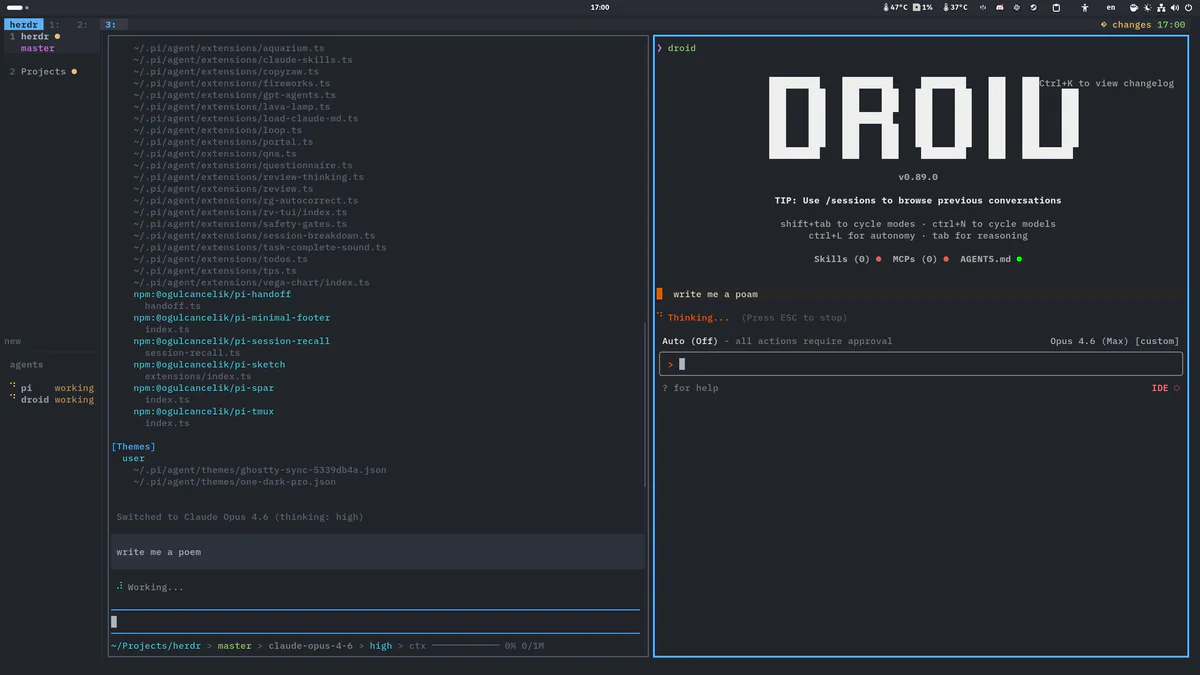
curl -fsSL https://herdr.dev/install.sh | sh. - Agent awareness sidebar with per-pane status: 🔴 blocked, 🟡 working, 🔵 done (unreviewed), 🟢 idle.
- Socket API plus reusable “agent skills” for programmatic workspace, pane and output control.
- 9 built-in themes (Catppuccin default), custom keybindings, mouse-native pane splitting and dragging.
Comparison
| Capability | herdr ≤ 0.4.x | herdr 0.5.0 | tmux |
|---|---|---|---|
| Session model | Single process (quit = kill agents) | Persistent server + thin client | Persistent server + clients |
| Agent awareness per pane | Yes | Yes | No |
| SSH reattach keeps agents alive | Partial | Yes | Yes (generic shells only) |
| Multi-client attach | No | Yes (shared view) | Yes (independent nav) |
| Per-client independent navigation | No | Not yet | Yes |
| Built-in agent integrations | Pi, Claude Code, Codex, OpenCode | Same + Droid, Amp, Gemini CLI, Cursor, Cline | None |
Use cases
- Commute-safe long refactors. Start a Claude Code refactor on your desktop, close the lid, check progress from your phone via SSH, reattach from the office laptop later.
- Agent box on a VM. Put herdr on a cheap cloud VM. Run a fleet of Codex, Claude Code and OpenCode agents on tickets. SSH in from whatever machine you're on.
- Pair debugging. Two engineers attach to the same session and watch the same agents work live.
- Flaky-Wi-Fi resilience. Network drop or accidental terminal close no longer kills in-flight agent work.
Limitations & pricing
- Free, AGPL-3.0. Derivative works (including network-served ones) must remain open-source.
- Linux and macOS only. No Windows client. No native iOS/Android app — phones need an SSH client.
- Multi-client is a shared view: two attached clients see the same panes and navigation. Tmux-style independent per-client windows are on the roadmap, not shipped.
- Full agent-state detection is only guaranteed for the tested integrations (Pi, Claude Code, Codex, OpenCode, plus Droid, Amp, Gemini CLI, Cursor Agent, Cline). Others are detected by process-name and output heuristics.
What's next
The obvious next step is tmux-parity for multi-client: independent navigation per attached client so two people can work in the same session without fighting over focus. Broader agent coverage (more first-class integrations instead of heuristics) and eventually Windows support are other likely directions, though neither has been officially committed.
Sources: herdr.dev, ogulcancelik/herdr on GitHub, herdr releases.