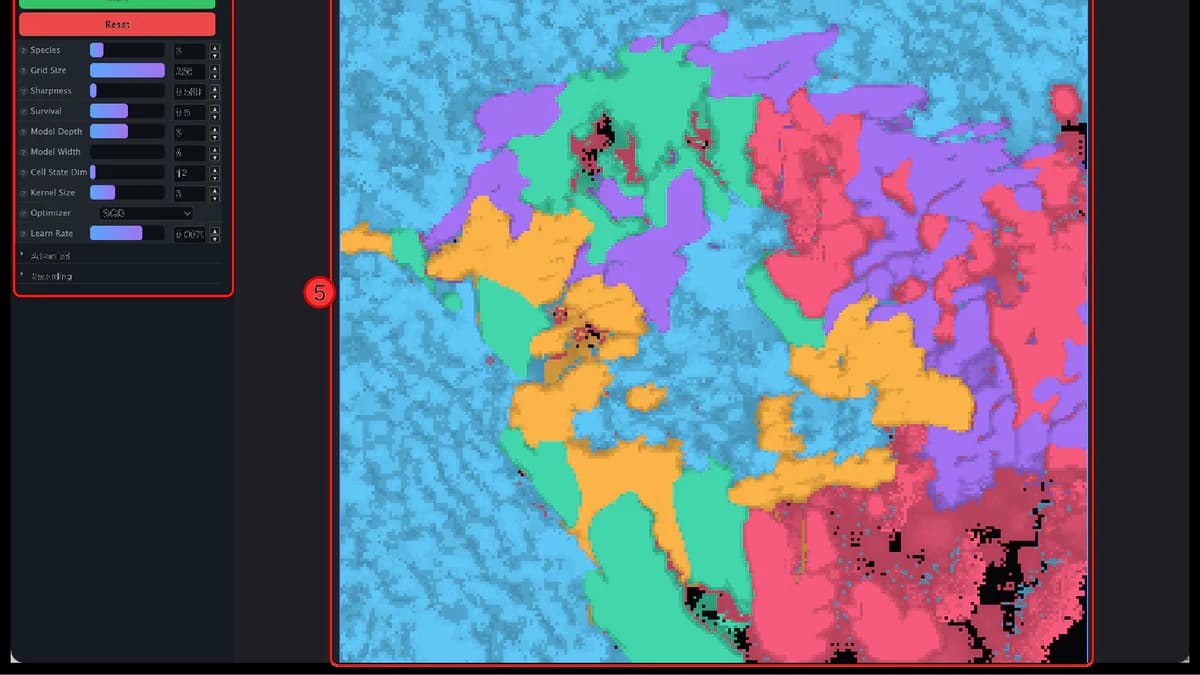

- Sakana AI just opened a browser-based playground where five small CNNs battle for territory on a 2D grid while learning via online gradient descent.
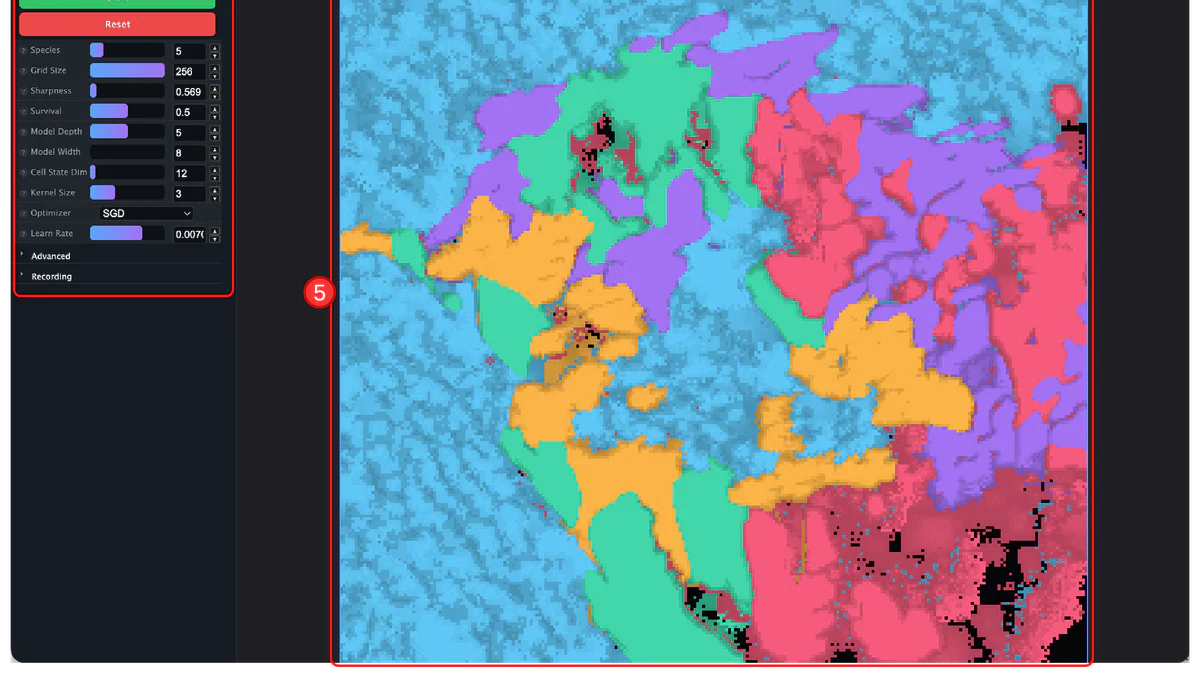
- Tweak 40+ parameters live, draw walls, checkpoint reality, and branch alternative futures — no GPU, no install.
TL;DR
Sakana AI released Digital Ecosystems in April 2026 — an open, browser-based platform where five small convolutional neural networks share a 2D Petri dish and fight for territory while learning in real time. Each "organism" sees only a local 3×3 neighborhood, has no global plan, and updates its own weights via online gradient descent during the simulation. You get 40+ live parameters, checkpoint/branch UX, drawable walls, and Shannon-diversity dashboards. All of it runs in TensorFlow.js + WebGL on a laptop.
What's new
Sakana's prior Petri Dish NCA was a non-interactive lab experiment. Digital Ecosystems is the first version you can actually play with: pause, scrub parameters, paint walls, hand-seed a species, save up to five manual checkpoints (plus autosave), export a .petri file, then branch six alternative futures from the same starting state.
Under the hood, the team (work led by Luke Darlow at Sakana AI) made six algorithmic changes versus PD-NCA v1:
- Soft growth gate
g_i(x,y) = σ(k_gate · (ã_i(x,y) − θ))— a differentiable sigmoid replaces v1's hard aliveness threshold. - Presence gating restricts competition to a dilated 3×3 of existing territory.
- Emergency respawn re-seeds a species with 5 cells if its aliveness drops below 1.
- Spatial concentration via sliding-window softmax kills dilute long-range influence.
- Win-rate EMA feedback makes high-aliveness cells update more frequently.
- Soft-minimum loss with entropy bonus balances weak-species focus against population diversity.
Why it matters
Classic Neural Cellular Automata train fixed rules for single-agent morphogenesis. Petri Dish NCA added multi-agent competition but ran offline. Digital Ecosystems is the first setup where multiple learning agents coexist, compete, and adapt while you watch and intervene. That turns ALife from a batch-rendered curiosity into a live instrument — closer to a microscope than a GIF.
It also sits naturally beside Sakana's ASAL work (foundation models searching for interesting artificial-life rules). ASAL automates discovery; Digital Ecosystems gives the human the joystick.
Technical facts
| Property | Digital Ecosystems (2026) | PD-NCA v1 (prior) |
|---|---|---|
| Species count | N = 5 | Multi-agent (varied) |
| Grid sizes | 128×128, 200×200, 256×256 | up to 196×196 |
| Per-cell observation | Local 3×3 | Local 3×3 |
| Backbone | MobileNetV2-style inverted residual blocks + per-species decoder | Simple convolutional update function |
| Optimizers tested | SGD, SGD+momentum, Adam | SGD-based |
| Learning mode | Online gradient descent during simulation | Online gradient descent during simulation |
| Growth gate | Differentiable sigmoid (soft) | Hard threshold |
| Interactivity | Live 40+ params, checkpoints, walls, seeds | None |
| Runtime | Browser (TensorFlow.js + WebGL + SwissGL) | Offline |
Comparison
Against classical NCA (Mordvintsev et al.), rules are static and there is a single morphogenetic target. Digital Ecosystems has five agents continuing to learn during the run, producing open-ended behavior classical NCA structurally cannot express.
Against Sakana's own PD-NCA v1, the headline delta is interactivity plus a differentiable growth gate and stability primitives (presence gating, emergency respawn) that stop the ecosystem from collapsing when you poke it. The MobileNetV2-style backbone and soft-minimum loss with entropy bonus also materially change the dynamics.
Against ASAL, the contrast is philosophical: ASAL uses vision-language foundation models to search ALife rule-space; Digital Ecosystems gives a human researcher a sandbox to steer a multi-agent learning system directly. Both are complementary lenses on open-endedness.
Use cases
The paper ships five case studies — each a qualitative n=1, but vivid:
- Edge-of-chaos control. The growth-gate steepness
k_gateacts as a learned Langton-λ: ~17.5 ordered / bistable, ~4.9 edge-of-chaos with cooperation fronts and texture regeneration, ~4.6 chaotic with no stable structure. - Flicker-mixing attractor. At extreme competition temperature
τ = 0.1, pixels flicker between species every step yet the system stays stable. The survival threshold acts as a temporal filter: 0.1 is noise, 0.5 is diffuse blobs, 0.8 is stable territories beneath flicker. - Emergent cooperation via threshold cycling. Permissive mixing (thr=0.2) → crystallization (thr=0.51) → cooperative relaxation (thr=0.39) produces checkerboard / dithered co-occupation between former enemies. A cold-start at constant thr=0.39 also reaches cooperation by ~step 1500 — with a different spatial distribution.
- Optimizer divergence from one checkpoint. Six branches (3 optimizers × 2 LRs) from identical state split qualitatively within ~50 steps: SGD clean equilibria; SGD+momentum rotating dominance cycles (~2500–5000 cells per species, species death at high LR); Adam wave-like repainting with ~9× amplitude swings and ~75% grid capture at high LR.
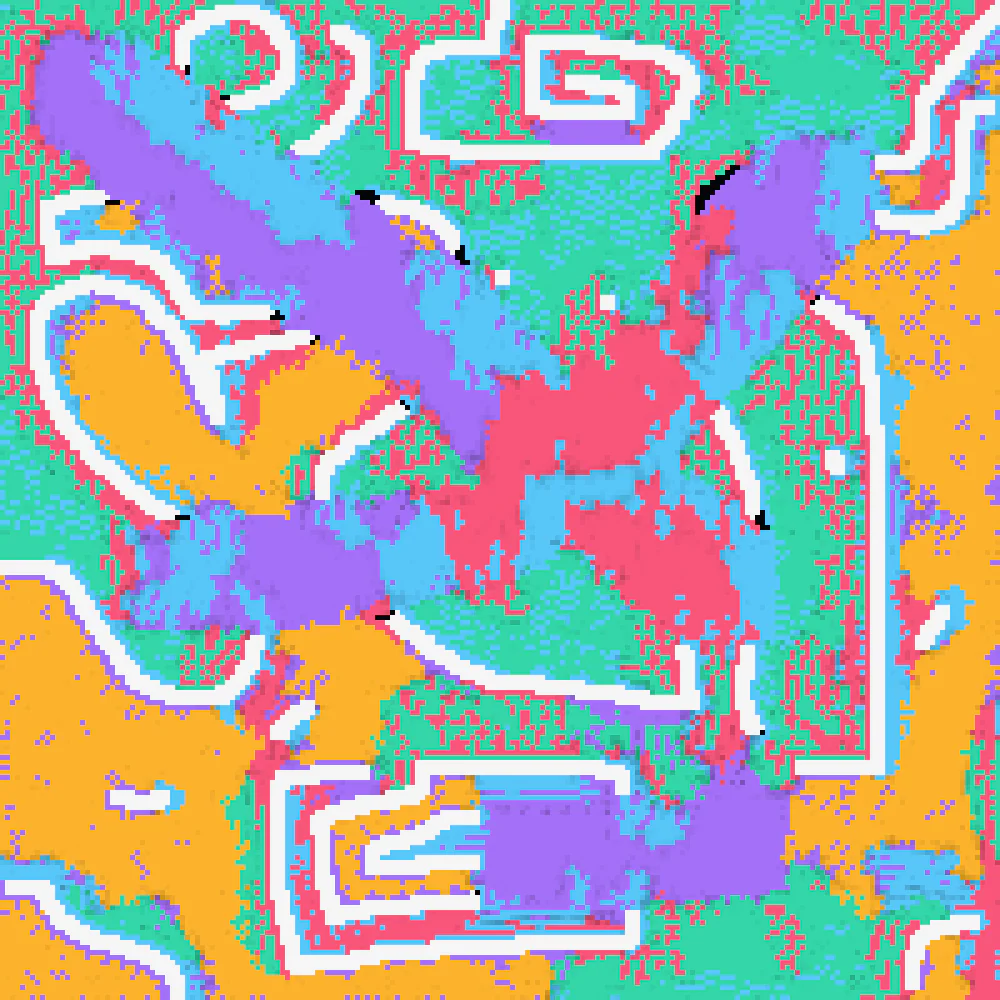
- Biogeographic construction. On a 200×200 grid with hand-drawn walls, species exhibit wall-hugging — using geometry as defensible safe zones. Erasing walls triggers invader dominance that the population-balancing loss corrects within ~70 steps. Enclaves can persist >1000 steps in protected alcoves.
Who actually uses this: ALife and complex-systems researchers, open-endedness labs, educators teaching emergence and self-organization, and ML researchers poking at multi-agent learning dynamics without booting a cluster.
Limitations & pricing
- Statistical caveat: each case study is a single observation, not a benchmark.
- WebGL non-determinism: ~26% cell-boundary disagreement across devices after 94 steps — not bitwise reproducible.
- Hard-coded N = 5 species; scaling is unexplored.
- Emergency respawn acts as an immigration floor, so observed coexistence is quasi-stationary rather than proof of purely emergent stability.
- Mobile performance is poor — laptop or desktop recommended.
- Pricing: free and open. Browser demo, paper PDF, and source code (
github.com/SakanaAI/digital-ecosystem) are public. No login, no GPU, no install.
What's next
The obvious frontiers: scale past N=5 species, richer environmental physics beyond walls, a reproducible simulation backend so identical seeds produce identical runs, and a community format around .petri checkpoints as shareable research artifacts. The paper explicitly frames its five case studies as five paths through a "vast parameter space" — most of that space is still untouched.
Sources: pub.sakana.ai/digital-ecosystem, PD-NCA v1, ASAL.