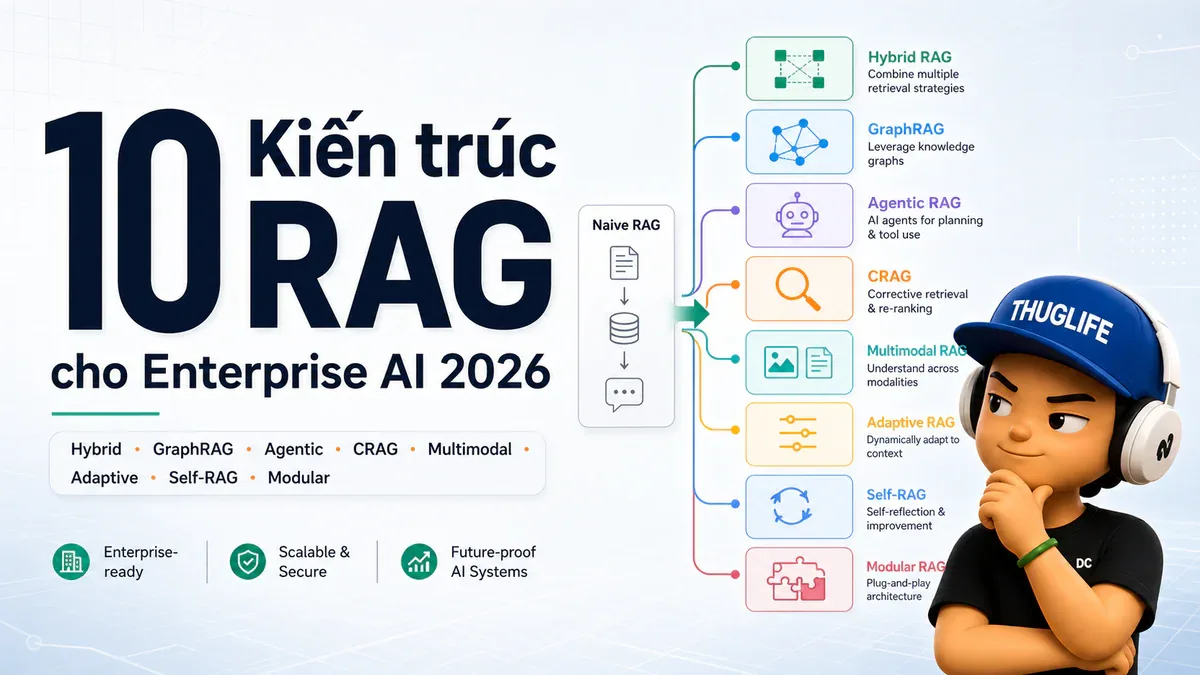

- Hybrid RAG kết hợp vector + BM25 là baseline production mặc định cho enterprise 2026.
- GraphRAG outperform Hybrid khi queries phụ thuộc relationship giữa entities.
- Agentic RAG xử lý multi-hop nhưng tốn 3-10x token và latency p50 = 4-8 giây.
- Lựa chọn kiến trúc RAG sai là lý do chính khiến dự án GenAI enterprise thất bại sau giai đoạn demo.
TL;DR
Năm 2026, RAG không còn là một "feature layer" được bolt-on vào LLM. Nó là hạ tầng chiến lược. Enterprise knowledge vượt quá hàng tỉ token - không context window nào đủ lớn. Governance yêu cầu audit trail, RBAC, PII redaction. Chi phí và latency là vấn đề ở cấp board. Lựa chọn kiến trúc RAG sai là lý do chính khiến các dự án GenAI thất bại sau giai đoạn demo. Bài này phân tích 10 kiến trúc RAG và framework để chọn đúng.
10 Kiến trúc RAG từ cơ bản đến nâng cao
1. Naive RAG - Điểm xuất phát
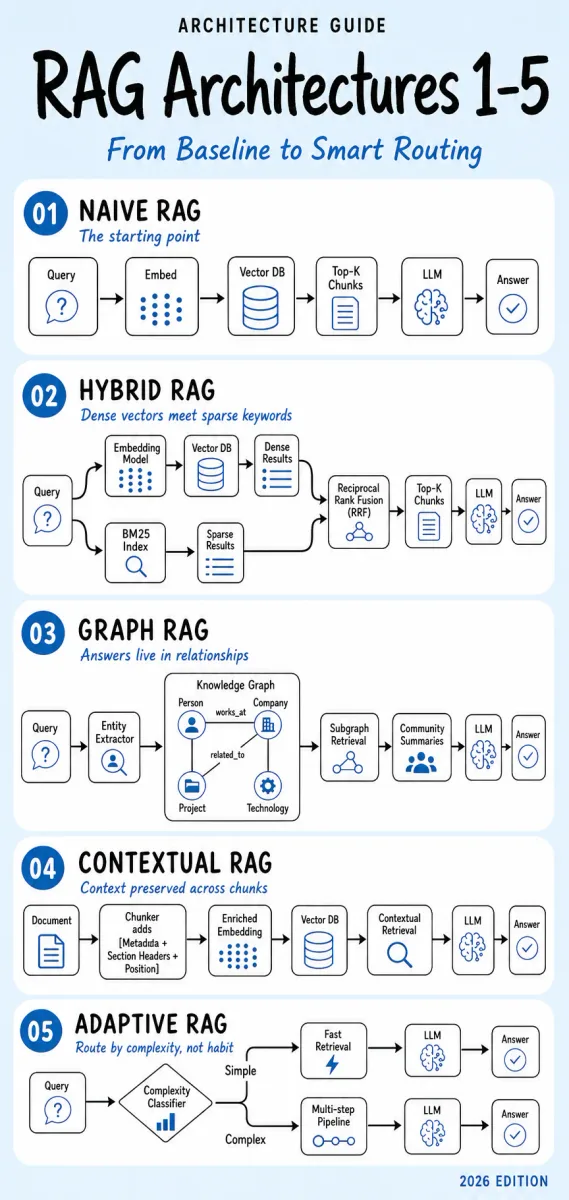
Vector embeddings + cosine similarity + top-k retrieval. Deploy trong vài ngày, giảm hallucination so với pure LLM. Hạn chế: không có multi-hop reasoning, không tự sửa lỗi khi retrieval thất bại, semantic similarity không đồng nghĩa với true relevance. Phù hợp: FAQ bot, HR policy assistant, internal docs đơn giản. Production readiness: High.
2. Hybrid RAG - Baseline enterprise mặc định
Parallel vector search + lexical search (BM25/TF-IDF) + re-ranking. Bắt được cả semantic understanding lẫn exact keyword matching - điều mà vector-only không làm được khi query chứa contract ID, policy number hay thuật ngữ pháp lý chính xác. Enterprise benefits: giảm false negatives/positives, higher recall & precision. Timeline deploy: 4-8 tuần. Production readiness: Very High.
3. Graph RAG - Retrieval dựa trên quan hệ
Entity extraction → knowledge graph → relationship traversal → subgraph retrieval. Graph RAG outperform Hybrid khi insight phụ thuộc vào mối quan hệ giữa các thực thể: fraud detection theo ownership chain, legal precedent analysis, supply chain dependencies, M&A due diligence. Multi-hop reasoning và explainability tốt. Trade-off: indexing cost cao, maintenance phức tạp, timeline 3-6 tháng. Production readiness: Medium.
4. Contextual RAG - Bảo toàn ngữ cảnh trong chunking
Vấn đề cốt lõi: chunking thông thường phá vỡ pronoun references và section continuity. Contextual RAG đính kèm document metadata, section headers, positional context vào từng chunk trước khi embed. Kết quả: disambiguation tốt hơn, xử lý long-form documents không bị context drift. Quan trọng nhất trong: healthcare, finance, government - các domain mà sai ngữ cảnh = sai quyết định.
5. Adaptive RAG - Routing theo độ phức tạp
Query classifier phân loại độ khó → simple queries đi đường fast retrieval, complex queries đi multi-step pipeline. Không tốn token của Agentic RAG cho câu hỏi đơn giản. Kết quả thực tế: cắt cost 30-50%, latency trung bình giảm 35% trên mixed-traffic systems (60-80% queries là simple lookups). Production readiness: High.
6. Agentic RAG - Retrieval thành autonomous reasoning
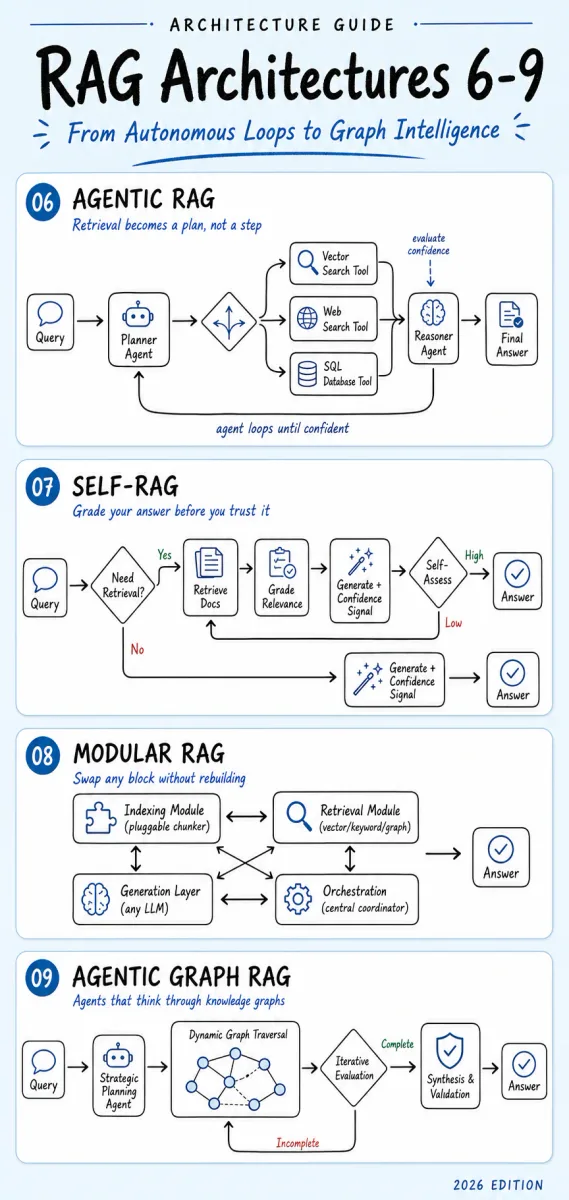
Retrieval không còn là passive lookup - nó trở thành active cognitive loop: task decomposition → tool invocation (vector DB, SQL, API, cloud storage, graph DB) → memory systems → iterative refinement. Cross-system intelligence thực sự. Trade-off nặng: latency p50 = 4-8 giây (vs vanilla 1-2s), token cost 3-10x, governance risk cao do autonomous tool usage, timeline 3-9 tháng. Chỉ dùng cho high-stakes multi-hop: tài chính, y tế, pháp lý, compliance audit. Production readiness: Emerging.
7. Self-RAG - Tự đánh giá trước khi trả lời
Thay vì luôn luôn retrieve, Self-RAG quyết định adaptive: có cần retrieval không? Sau đó tự đánh giá relevance của retrieved docs, generate answer kèm confidence signal, iterative correction nếu confidence thấp. Kết quả: reduced hallucinations, confidence scoring hỗ trợ explainability. Hạn chế: cần specialized training, computational overhead cao, monitoring phức tạp. Phù hợp: medical AI copilot, legal research, investment advisory. Production readiness: Emerging.
8. Modular RAG - Kiến trúc composable
Retrieval, indexing, generation, orchestration là các building block độc lập và có thể swap. Swap embedding model mà không rebuild toàn bộ system. A/B test retrieval strategies trong production. Các department khác nhau dùng retrieval strategy khác nhau trên cùng một platform. Trade-off: engineering investment cao hơn, interface management phức tạp. Lý tưởng cho enterprise scale AI across nhiều domain.
9. Agentic Graph RAG - Convergence của 3 paradigm
Autonomous agents + knowledge graphs + retrieval augmentation. Thay vì traverse graph theo đường cố định, agents dynamically quyết định entities nào cần explore, path nào ưu tiên, khi nào backtrack, khi nào tổng hợp kết quả. Use cases: fraud detection theo ownership chain, supply chain risk analysis, complex litigation research, national security intelligence. Limitations: computational cost rất cao, observability & debug cực kỳ khó, chỉ dùng cho high-value investigative systems.
Ma trận so sánh
Kiến trúc | Complexity | Latency | Governance Risk | Production Readiness |
|---|---|---|---|---|
Naive RAG | Thấp | Thấp | Trung bình | High |
Hybrid RAG | Trung bình | Trung bình | Thấp | Very High |
Graph RAG | Cao | Trung bình-Cao | Thấp | Medium |
Contextual RAG | Thấp-TB | Thấp | Thấp | High |
Adaptive RAG | Trung bình-Cao | Optimized | Trung bình | High |
Agentic RAG | Rất cao | Variable | Cao | Emerging |
Self-RAG | Cao | Cao hơn | Rất thấp | Emerging |
Modular RAG | Cao | Flexible | Trung bình | High |
Agentic Graph RAG | Cực cao | Cao | Cao | Niche |
Framework chọn kiến trúc
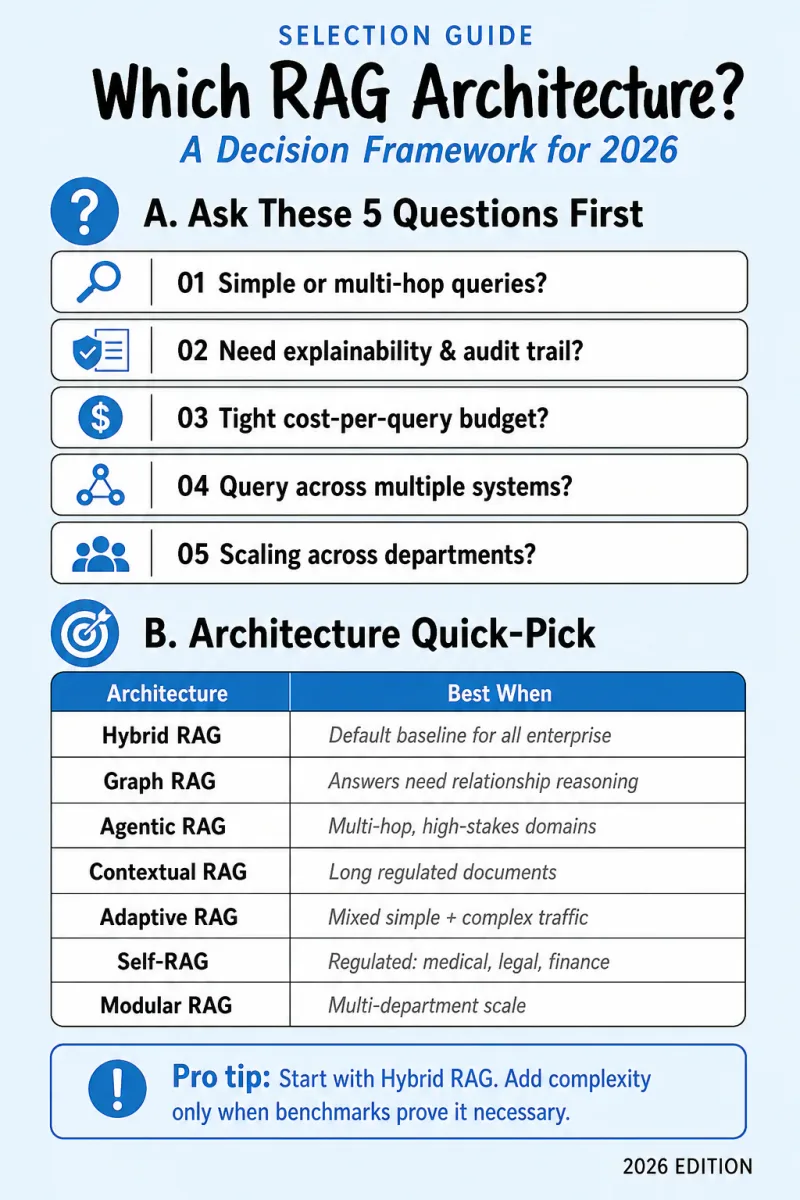
Trước khi chọn, trả lời 5 câu hỏi sau:
Query complexity: Single-fact hay multi-hop analytical? - Simple → Hybrid. Multi-hop → Agentic.
Governance sensitivity: Regulated environment cần explainability? - Có → Self-RAG hoặc Graph RAG (traceable reasoning chains).
Cost sensitivity: Cost-per-query bị constrain chặt? - Có → Adaptive RAG để route smart.
System integration: Cần query nhiều database, API, knowledge graph khác nhau? - Có → Agentic RAG.
Scalability horizon: Multi-department hay domain-specific? - Multi-domain → Modular RAG.
Rule ngắn: Hybrid RAG là default cho hầu hết. Graph RAG khi reasoning phụ thuộc relationships. Agentic RAG chỉ khi thực sự cần - nó 3-10x đắt hơn và chậm hơn đáng kể.
Quan sát bắt buộc - Production không thể thiếu
RAG systems degrade silently nếu không có observability. Các metric bắt buộc phải monitor:
Retrieval precision & recall - track weekly, alert khi Recall@5 drop >3%
Hallucination rate - faithfulness ≥ 0.9 (Ragas metric)
Latency per query - p50 và p95 riêng biệt
Cost per request - monitor p99 cost, không chỉ mean
Confidence scoring - hỗ trợ explainability cho regulated domains
Drift detection - embedding drift, corpus drift, eval drift
Governance requirements: RBAC, data lineage tracking, retrieval logging & audit, PII redaction, model output auditing. Thiếu bất kỳ layer nào → system fail silently trong production.
Lộ trình 2026-2027
RAG đang evolve từ retrieval utility thành enterprise intelligence framework. Hướng đi:
Hybrid baselines trở thành standard tối thiểu cho mọi enterprise
Adaptive cost-aware pipelines giảm operational cost mà không hy sinh reasoning depth
Agentic orchestration cho complex multi-step workflows
Self-correcting reliability layers cho regulated domains
Composable modular ecosystems để scale cross-department
Context windows 1M+ token không thay thế RAG - chúng làm precision retrieval quan trọng hơn, không kém hơn. Enterprise knowledge bases thường vượt hàng tỉ token. Inject raw data vào context window = lãng phí compute + governance risk + operational imprecision. Theo Gartner, hơn 70% enterprise GenAI initiatives sẽ cần structured retrieval pipelines vào cuối 2026.
Đạo hữu là phàm nhân, tu tiên giả
... hay AI cào nội dung?
Tất cả nội dung tại đạo quán đều miễn phí. Đạo hữu chỉ cần nhập email của mình để đọc tiếp. Nói KHÔNG với Spam. Huỷ subcribe lúc nào đạo hữu thích.
nếu không muốn nhận newsletter thì có thể nhập mail phụ