- Shuffle just added Moonshot AI's Kimi 2.6 across every tool, including the Multi-AI Designer.
- Write one prompt, get parallel website designs from Claude Opus 4.7, GPT-5.4, Gemini 3.1 Pro, and Kimi K2.6 — then ship the best as Next.js, Laravel, WordPress, or a design.md hand-off.
TL;DR
Shuffle has rolled out Kimi 2.6 across its entire toolset, including the Multi-AI Designer. You write one prompt and four frontier models — Claude Opus 4.7, GPT-5.4, Gemini 3.1 Pro, and Kimi K2.6 — simultaneously generate independent website designs. Compare side-by-side, pick the winner, export as production code (Next.js, Laravel, WordPress, HTML/CSS) or a design.md file for downstream coding agents.
What's new
Kimi 2.6 is the new arrival. It's Moonshot AI's latest open-weight agentic coding model — a 1-trillion-parameter Mixture-of-Experts with 32B active parameters, released in Code Preview on April 13, 2026. Shuffle is one of the first design tools to integrate it natively, and the integration is now live across every Shuffle surface: the main editor, the AI Design Arena, and the Chrome/Firefox redesign extensions.
Crucially, Kimi 2.6 is the only open-weight model in Shuffle's frontier lineup. Everything else — Opus, GPT, Gemini — is proprietary. That changes the economics of multi-model design: users now get real model diversity without being locked into three closed ecosystems.
Why it matters
The single biggest weakness of single-model AI design tools is prompt anchoring: you only see what one model thinks you want, and you don't know what you missed. Shuffle's pitch — "AI gets you 80% there, the editor handles the last 20%" — relies on having a strong 80% to start from.
Running four models in parallel on the same brief surfaces layouts and typographic choices you'd never have prompted your way to. Each model has a distinct aesthetic prior, and Kimi 2.6 adds a fourth data point that's independent of the OpenAI/Anthropic/Google trio. For solo founders and agencies, that's a meaningful widening of the design search space for zero extra effort.
Technical facts
What the numbers say about Kimi K2.6 itself:
| Benchmark | Kimi K2.6 | Closest proprietary |
|---|---|---|
| SWE-Bench Verified | 80.2% | Claude Opus 4.6 — 80.8% |
| SWE-Bench Pro | 58.6% | — |
| HLE-Full (with tools) | 54.0% | GPT-5.4 — 52.1% |
| BrowseComp | 83.2% | GPT-5.4 — 82.7% |
| Agent swarm | 300 sub-agents, 4,000 steps | K2.5 — 100 / 1,500 |
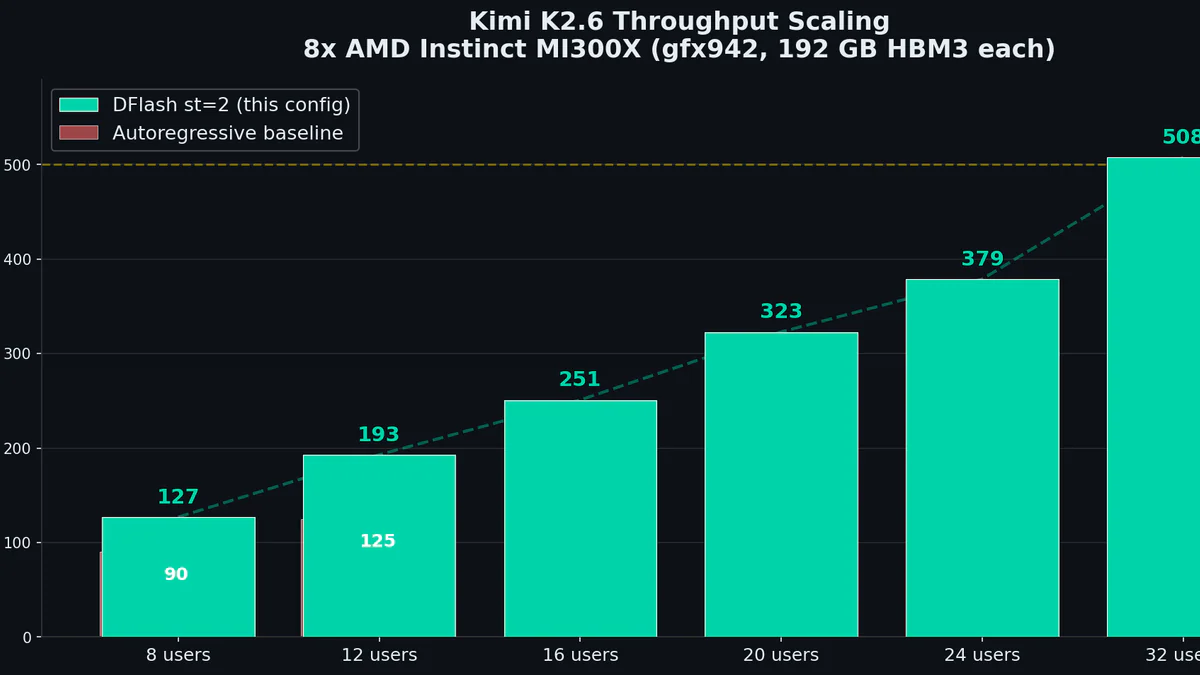
In a 13-hour continuous execution test, K2.6 posted a 185% jump in median throughput (0.43 → 1.24 MT/s), iterating independently across 12 optimization strategies. BenchLM currently ranks it #13 out of 110 models overall. Translated to Shuffle: you're getting a model tuned for long, autonomous, multi-step work — not just one-shot generation.
Comparison: the Multi-AI Designer lineup
- Claude Opus 4.7 — conservative, typography-heavy, strong hierarchy
- GPT-5.4 — trend-aware, bold layouts, strong copy integration
- Gemini 3.1 Pro — grid-native, data-dense, clean spacing
- Kimi K2.6 — open-weight, strong on component semantics and coded polish (SWE-Bench near-Opus parity shows up as cleaner exported code)
Each variant arrives in a live preview grid. You pick one, open it in Shuffle's drag-and-drop editor, and tweak components, colors, typography — no code required until export.
Use cases
- Solo founders: four landing-page concepts in a single prompt — ship today, A/B test tomorrow
- Agencies & freelancers: client pitches where you show four directions live instead of one "best guess"
- Developers: export the winner to
design.mdand hand off to your coding agent (Claude Code, Cursor, Kimi Code) for implementation - Redesigns: the Chrome/Firefox extension lets you paste an existing URL (including password-protected and local sites) and get four parallel redesigns — useful for refresh audits
Limitations & pricing
Shuffle runs on three paid tiers: $24/month, $99/year, or a $249 lifetime license — though the lifetime price jumps to $399 on April 22, 2026, so there's effectively 24 hours of runway on the cheaper deal. The lifetime bundle includes 2.5M AI tokens during the promo. The redesign browser extensions are free.
Caveats: Multi-model output still requires a human editor for production-grade polish. Kimi K2.6 itself is in Code Preview until formal release (expected May 2026), so edge-case behavior may shift. And running four frontier models on every prompt burns tokens fast — the 2.5M allocation in the lifetime tier goes quickly if you iterate heavily.
What's next
Two threads worth watching: Moonshot's formal K2.6 release in May, which should bring API stability and broader availability; and Shuffle's design.md export format, which is quietly positioning itself as a neutral hand-off layer between design tools and coding agents. If that format gets picked up by more tools, Shuffle becomes a design-first entry point into the agentic-coding pipeline — not just another AI page builder.
Sources: @ShuffleEditor, shuffle.dev/ai-design, kimi-k2.org, Kilo blog, BenchLM.