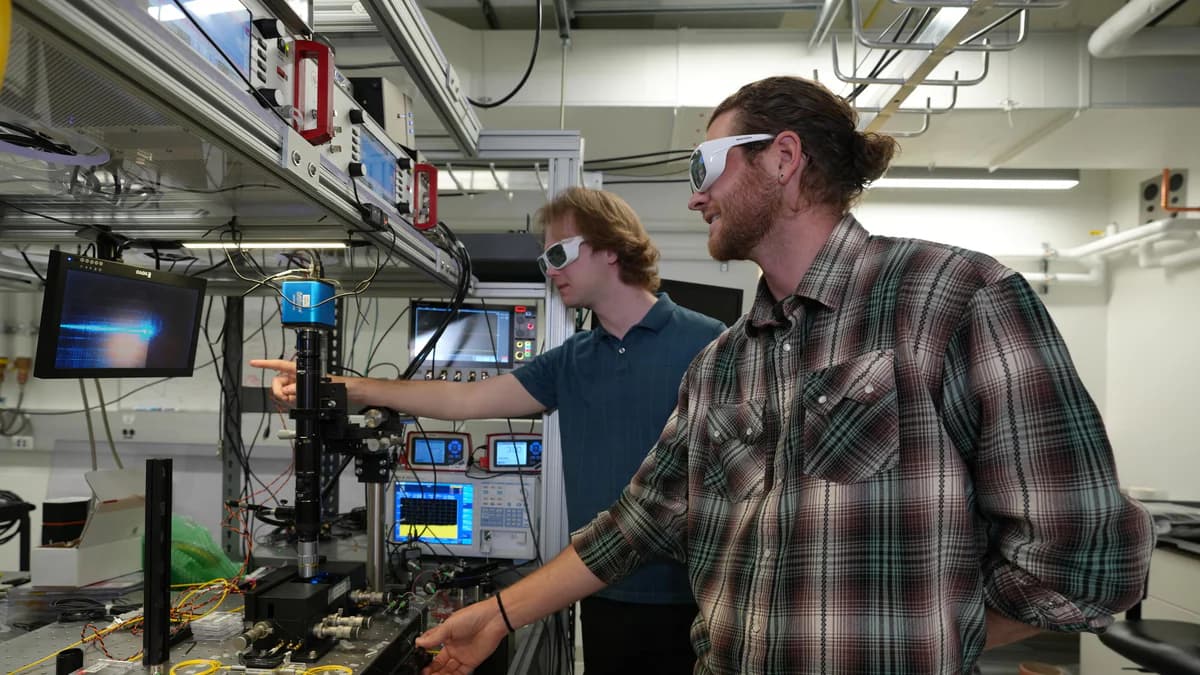

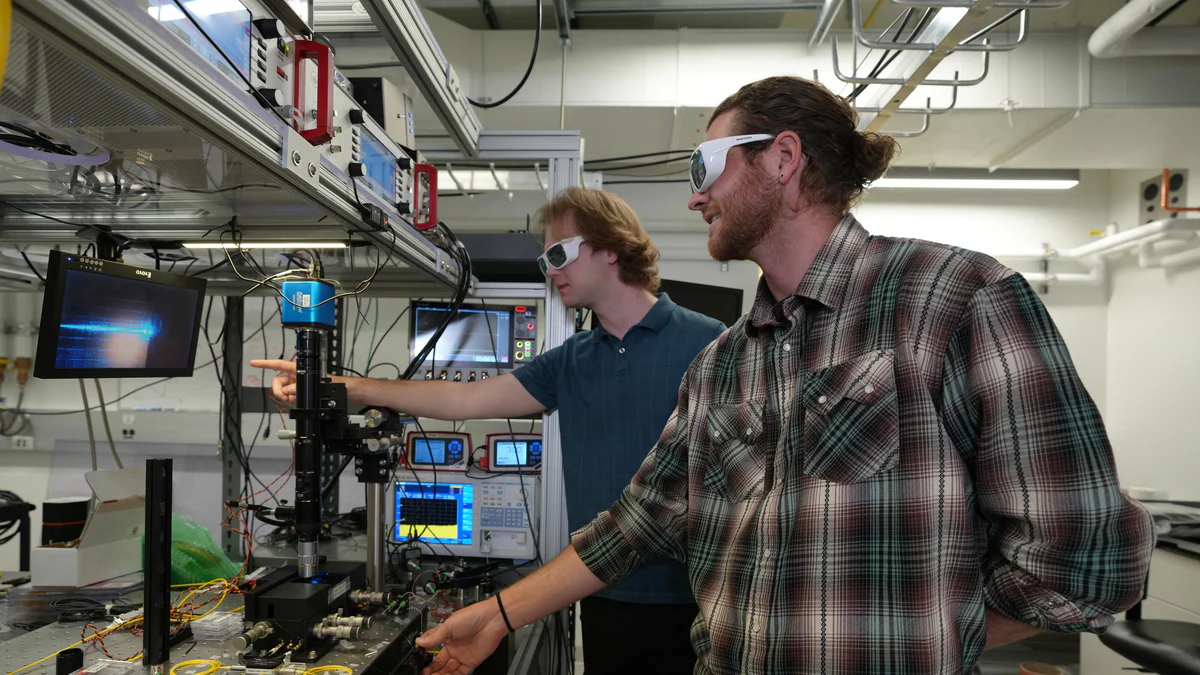
- NIST researchers just published the first monolithic 3D photonic platform — 570 nm of tantala deposited directly on 300 nm thin-film lithium niobate — and it handles OPO, microcombs, SHG and interlayer routing on a single chip.
- 10,000 programmable-color circuits per die, 50 dies per wafer.
TL;DR
A NIST team led by Scott Papp has monolithically stacked tantalum pentoxide (Ta₂O₅, "tantala") on thin-film lithium niobate and run five different nonlinear optical processes on the same chip — χ⁽³⁾ OPO, dark-pulse microcombs, supercontinuum, χ⁽²⁾ second-harmonic generation, and 3D interlayer routing. Published in Nature on April 15, 2026. Interlayer taper loss is only ~0.2 dB at 1550 nm, tantala ring Q hits ~5 × 10⁶, and a single wafer fits ~50 chips × 10,000 programmable-color circuits.
What's new
Integrated photonics has always had a material problem. Silicon nitride is low-loss but has no electro-optic effect. Thin-film lithium niobate (TFLN) has world-class electro-optics and χ⁽²⁾, but middling third-order nonlinearity. Tantala has excellent χ⁽³⁾ but no electro-optics. Until now, combining them meant heterogeneous bonding — fragile, thermally stressed, misaligned.
The NIST + Octave Photonics team bypassed that entirely. They sputter-deposit 570 nm of tantala directly on top of a 300 nm TFLN-on-silicon wafer at room temperature, anneal at low temperature, and pattern both layers. The low stress and thermal budget mean the LN underneath survives intact. Vertical tapers connect the two layers with ~0.2 dB loss per transition at 1550 nm (~0.5 dB at 780 nm).
Why it matters
This is the first platform where one monolithic die gives you χ⁽³⁾ + χ⁽²⁾ + low-loss passives + (latent) electro-optics in one stack. Quote from lead author Grant Brodnik: "The real power is that tantala can be added to existing circuitry." That is the point — you do not rebuild TFLN foundries, you stack on top.
Scott Papp frames the scale: "We can create all these different colors, just by designing circuits." On one beer-coaster-sized wafer they fit roughly 50 chips, each with up to ~10,000 circuits, each circuit programmable to output a distinct wavelength.
The broader shift here is conceptual. Photonics has historically been 2D — you pick a material, pattern waveguides, and accept what that material does. This work treats photonics more like CMOS: vertical layering, tight interlayer vias, and each layer specialised. Stack a χ⁽³⁾ engine on top of a χ⁽²⁾ + electro-optic foundation and suddenly one die handles laser generation, frequency conversion, modulation, and routing — functions that used to need entire optical tables.
Technical facts
| Parameter | Value |
|---|---|
| Tantala film thickness | 570 nm |
| TFLN thickness / etch depth | 300 nm / ~150 nm partial etch |
| Cladding | 20 nm ALD SiO₂ |
| Tantala ring intrinsic Q | ~5 × 10⁶ (4 µm wide ring) |
| Interlayer taper loss | ~0.2 dB @ 1550 nm, ~0.5 dB @ 780 nm |
| Taper geometry | 250 µm long, 2 µm → 150 nm width |
| PPLN-only SHG efficiency | 13,000 %·W⁻¹·cm⁻² (35 mW → 6 mW) |
| Stacked SHG @ 485 nm | 2,200 %·W⁻¹·cm⁻² (84 mW → 5 mW) |
| Stacked SHG @ 787 nm | 4,500 %·W⁻¹·cm⁻² (87 mW → 11 mW) |
| Broadband χ⁽³⁾ OPO span | 968 nm pump → 698 nm / 1572 nm (octave-spanning) |
Comparison
How this stacks against prior photonic platforms for a unified nonlinear palette:
| Platform | Low-loss | χ⁽²⁾ | χ⁽³⁾ | Electro-optic | 3D stacking |
|---|---|---|---|---|---|
| Silicon nitride | Excellent | None | Moderate | None | Limited |
| Thin-film LN | Good | Excellent | Moderate | Excellent | Limited |
| Tantala (standalone) | Excellent | None | Excellent | None | n/a |
| Tantala on TFLN (this work) | Excellent | Excellent (poled LN) | Excellent (tantala) | Latent (LN layer) | Yes, 0.2 dB via |
This is the first platform to hit all four capability columns on a single monolithic die without heterogeneous bonding.
Use cases
- Optical atomic clocks — visible and IR references co-generated on one chip for portable clock standards.
- Quantum computing — entangled photon pair sources, qubit-addressing lasers at arbitrary visible wavelengths.
- AI / datacenter optical interconnects — soliton microcomb WDM sources for multi-Tbps routing on a single laser.
- VR/AR displays — compact RGB via SHG to 485 / 525 / ~635 nm from IR pumps.
- GPS-denied navigation — chip-scale optical frequency references.
- Science — dark matter searches, volcano and earthquake precursor monitoring, spectroscopy for drug and materials chemistry.
Limitations & pricing
- Stacked-SHG efficiency (2,200–4,500 %·W⁻¹·cm⁻²) is still below PPLN-only (13,000 %·W⁻¹·cm⁻²) — interlayer coupling adds loss.
- Integrated electro-optic modulation is not demonstrated in the same die in this paper, though the LN layer supports it.
- Not production-ready. Research demonstration at wafer scale, not commercial volumes.
- Thermal stability under sustained high-power operation not fully characterized.
- No public pricing — this is open research; Octave Photonics (Louisville, CO NIST spin-out) is commercializing.
What's next
Per Papp and Brodnik, the roadmap is: extend monolithic tantala stacking to other substrates (silicon nitride, SOI), close the loop on integrated electro-optic tuning + nonlinear generation on the same chip, reduce interlayer loss further, and scale the 10,000-circuits-per-chip programmable-color architecture toward shipping atomic-clock and AI-interconnect products via Octave Photonics.
We are past the era of picking one photonic material and living with the trade-offs. 3D monolithic stacking makes photonics composable the way CMOS has been for decades.
Nguồn: Nature (Brodnik et al., 2026), NIST press release, arXiv 2509.08092.